
Checking for a Warrant in Temple
Temple's clearest official route is the Police Administrative Division. The city charges that division with maintaining Municipal Court warrants and updating GCIC and NCIC files. It also works with the Municipal, Juvenile, and Superior Courts and takes public requests. Call 770-562-3369, or fax 770-562-9440. Ask whether the matter belongs to Temple Municipal Court, and what identity or case information the office needs.
- Read the Temple citation or notice for the named court and date.
- Call Police Administration or the municipal clerk for the city process.
- Ask what can be confirmed and whether an in-person visit is required.
- Use the Carroll County Sheriff only for county routing or when directed.
- Consult counsel before appearing if an active warrant may lead to arrest.
Georgia offers no statewide public warrant-name search. For Temple, use the city offices; for another county's warrant, check that county's sheriff.
Temple Warrant Files Are Not Public Search
Temple describes its internal warrant work openly. What it does not publish is a name-search form, public roster, status filter, or results table. Maintaining GCIC or NCIC entries is one thing; granting public access to those systems is another. No Temple portal lets a resident type in a name. And an outside service is never the city's database.
Quick answer: Temple Police Administration or the municipal clerk is the first official contact for a city warrant question.
Temple posts no public warrant roster. A records request can still seek a releasable document. It does not guarantee immediate status confirmation, and protected content may be redacted. Ask the city office which channel fits the purpose.
Temple Police and Municipal Court
Temple Police sits at 240 Carrollton Street, Temple, GA 30179. Its Administrative Division works with the Municipal Court. It also maintains reports and criminal-history records. The city's municipal warrant files sit on the enforcement side, updated by police, while Municipal Court issues its process under city authority. For a Temple matter, start with these two offices.
Temple Police Administration
Municipal warrant-file maintenance, public reports, and official routing.
770-562-3369
Temple Municipal Court
City case settings, orders, and warrant status within municipal authority.
770-562-3369
Not every case belongs to the city. Temple may refer callers to Magistrate, State, or Superior Court, or to the Carroll County Sheriff, when the matter is a county felony, misdemeanor, or other non-city case. Treat the county route as a fallback.
Temple Municipal Court Moved in 2025
Temple issued a dated notice that Municipal Court moved beginning August 1, 2025. Court is held at the William Simmons Administration Building, 240 Carrollton Street. This current notice supersedes an older city report that described a recreation-building arrangement. Anyone using an old citation, saved directions, or older web reference should confirm the present place before traveling.
The official Temple court-location notice documents the change.
The Temple Municipal Court location notice is linked with this source capture.
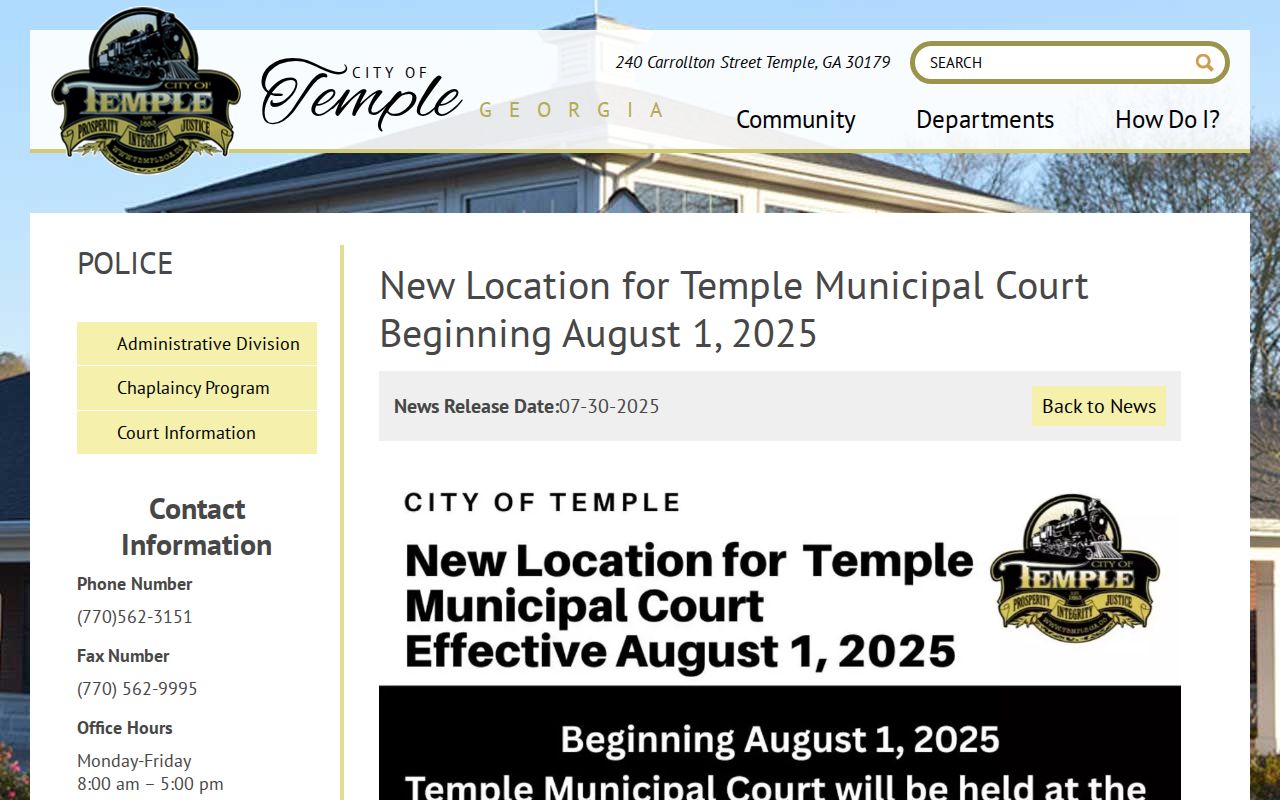
The notice ties Temple warrant follow-up to the right building. It is a location notice only, not a public warrant list or a promise of walk-in status checks.
Note: Call Temple before visiting because a location notice does not state the current warrant-confirmation or walk-in procedure.
Temple Warrant Types
Temple residents can meet several kinds of court process. A municipal bench warrant can follow a missed city obligation. A traffic FTA often starts with a Temple citation. A Carroll County court can issue an arrest warrant when the matter sits outside city jurisdiction. A search warrant authorizes a search; it is not a roster of wanted people.
| Process | How it arises | Likely office |
|---|---|---|
| Municipal bench warrant | Missed Temple court duty | Temple Municipal Court |
| Traffic FTA process | Failure to answer a city citation | Temple Municipal Court |
| County arrest warrant | Judicial process beyond city scope | Carroll County issuing court |
| Search warrant | Authority to search under judicial process | Issuing court and serving agency |
The issuing court matters most. Temple Police may maintain an entry, but a judge or clerk controls the court record and any later recall.
Temple Warrant Entry Workflow
Temple is unusually plain about its warrant workflow. The Administrative Division maintains and updates warrants issued by Municipal Court, along with GCIC and NCIC files, and it coordinates with the Municipal, Juvenile, and Superior Courts. That statement documents an internal records role only. It opens no public door into criminal-information systems, and it builds no public name index. A status question still has to be precise. Ask whether Temple Municipal Court issued the process. Ask whether Police Administration can confirm the current entry, or whether another court must answer instead. If Temple points you to a county court, note that court's name. Do not assume every Temple entry shows up in a sheriff's web source. Carroll County posts no countywide public warrant roster either.
Inside a Temple Warrant Record
Temple publishes no sample warrant record or results screen. These fields are a checklist for an official answer. They are not a transcription of any live record, so use only the identifiers and status terms the city releases.
| Identity | Name and lawful matching detail requested by the official office |
|---|---|
| Issuing court | Temple Municipal Court or the named county court |
| Reference | Exact case or warrant identifier if released |
| Basis | Missed setting, alleged violation, or other court-stated reason |
| Bond or fine | Amount only when the court confirms it |
| Status | The office's current term, such as active, served, or recalled |
No local number format should be invented.
Temple Records Service Boundaries
Temple Police Administration lists criminal-history checks and report services as separate offerings. A criminal-history check carries a stated $20 fee, and a report copy costs $5 after the processing period the city describes. Cash-exact, money order, and card payments are accepted. None of it equals instant warrant confirmation. A criminal-history product, a report copy, and live Temple warrant status serve different purposes. Ask what the fee buys before paying. A report request may return a public incident record. Background requests may hit identity or consent rules. Neither answer proves a Temple Municipal Court warrant is current or recalled; that question stays with the Temple office that maintains the warrant and the court that issued it.
How Temple Warrants Fit the County System
A Temple citation or municipal warrant starts inside city hall, where Temple Municipal Court and Temple Police Administration handle it. Some matters fall outside city jurisdiction. Those can move to Carroll County Magistrate, State, Juvenile, or Superior Court. The Carroll County Sheriff can route county enforcement calls. Georgia runs no public one-stop warrant-name search.
Warrant flow: Temple Municipal Court / Police Administration › Carroll County Sheriff or issuing county court › official state systems without public name access
The Carroll County warrant records overview maps the county. Start with Temple, and move outward only when the city or your paperwork points to a county matter.
Temple Old-Address Warrant Scenario
An old Temple citation may list a court address that no longer applies. Do not assume the case moved or closed. The 2025 notice changed where court is held, not each case's legal state. Call Temple Police Administration or the municipal clerk with your citation reference. Then ask for the right court location and procedure.
- Compare the citation date with the August 1, 2025 move.
- Use the official city number instead of an old directory entry.
- Ask whether the setting, case, or warrant remains current.
- Request written instructions when available.
- Speak with counsel before an appearance if custody is possible.
Bremen, by contrast, publishes a monthly arraignment schedule. Temple's defining local fact is the documented court move and its Administrative Division's warrant-file role.
Temple Warrant Records and Public Access
Georgia's Open Records Act, O.C.G.A. §§ 50-18-70 through 50-18-77, opens public records unless another law or court rule protects them. Temple Police keeps its own agency records. Temple Municipal Court holds the city court files. County custodians handle Carroll County records. Name a document, date range, agency, and delivery method in your request.
Key rules:
Georgia Open Records Act guidance explains the public presumption, exemptions, and agency response.
Carroll County Open Records is for county records, not a substitute for Temple's city custodian.
Sealed, juvenile, investigative, victim, and other protected details may be withheld or redacted.
A denial or partial response does not prove that no Temple warrant exists. Ask the custodian to cite the legal basis for anything withheld.
Temple Warrant Terms and Status
Temple's file-maintenance wording can sound broader than public access. Keep definitions plain so an internal entry never poses as a public result.
- GCIC
- Georgia's criminal-information system used by authorized agencies, not a public name portal.
- NCIC
- A national law-enforcement information system with controlled access.
- Bench warrant
- A judge's warrant tied to a missed court duty.
- Recall
- The issuing court withdraws the warrant by official action.
- Served
- The warrant was executed, though the case may continue.
Only the responsible Temple office can confirm the current warrant label. A payment receipt or old notice cannot do that alone.
Temple Warrant Resolution Route
If Temple confirms a warrant in your name, ask which court issued it and what that court requires. Counsel can weigh a voluntary appearance, surrender, bond question, motion, recall request, or new setting. Paying a fine does not automatically withdraw a warrant. The court must confirm what each step does.
Important: Get legal advice before visiting in person because an active Temple warrant may lead to immediate custody.
Keep every order, receipt, and notice. Ask whether the court record and police entry match. If they conflict, go back to the issuing court rather than relying on an outside service.
Temple Warrant Confirmation Notes
Write down the Temple office, call date, staff instructions, court, and the exact status words used. Temple matters may stop there. Ask whether the answer covers Temple Municipal Court alone or also involves a Carroll County court. When the city redirects you, note why. A clear chain avoids repeating personal identifiers. Never confront anyone over a suspected warrant, and use 911 only for immediate danger. A routine civic question goes to official city and county numbers. Ignore callers demanding gift cards, prepaid funds, or instant payment to remove a warrant; hang up and verify through a court or police number you found yourself.
Temple Warrant Document Trail
A citation, court calendar, warrant order, police entry, report copy, and payment receipt each answer a different question. A Temple citation opens a court path. A warrant order records judicial action. Temple police systems hold authorized agency information. A receipt shows a transaction. Stretch none beyond its stated purpose. When a Temple record changes, ask whether each office that needs the new order actually received it. Keep a dated copy. After the 2025 court move, an old online notice may show a superseded place even though the case remains live, so ask for written instructions when records conflict.